“My ambition is to contribute to elevating our relations to the level of a strategic partnership. To achieve this, my key priority is to promote economic cooperation – expanding trade, attracting investment and facilitating cooperation between our business communities,” says Kairat Abdrakhmanov, Ambassador of Kazakhstan to the Czech Republic, in an exclusive interview for TRADE NEWS.
Mr. Ambassador, you were officially introduced to your post in the Czech Republic only at the beginning of this year. What are your first impressions of our country and what priorities have you set for your time in Prague?
I have had the privilege of visiting the Czech Republic on multiple occasions in the past, including during my tenure as the Permanent Representative of Kazakhstan to the OSCE in Vienna and most recently as the OSCE High Commissioner on National Minorities. Each time, I have been impressed by the rich history of your country, its dynamic economy and the openness of its people. I am very pleased to have returned to your beautiful country.
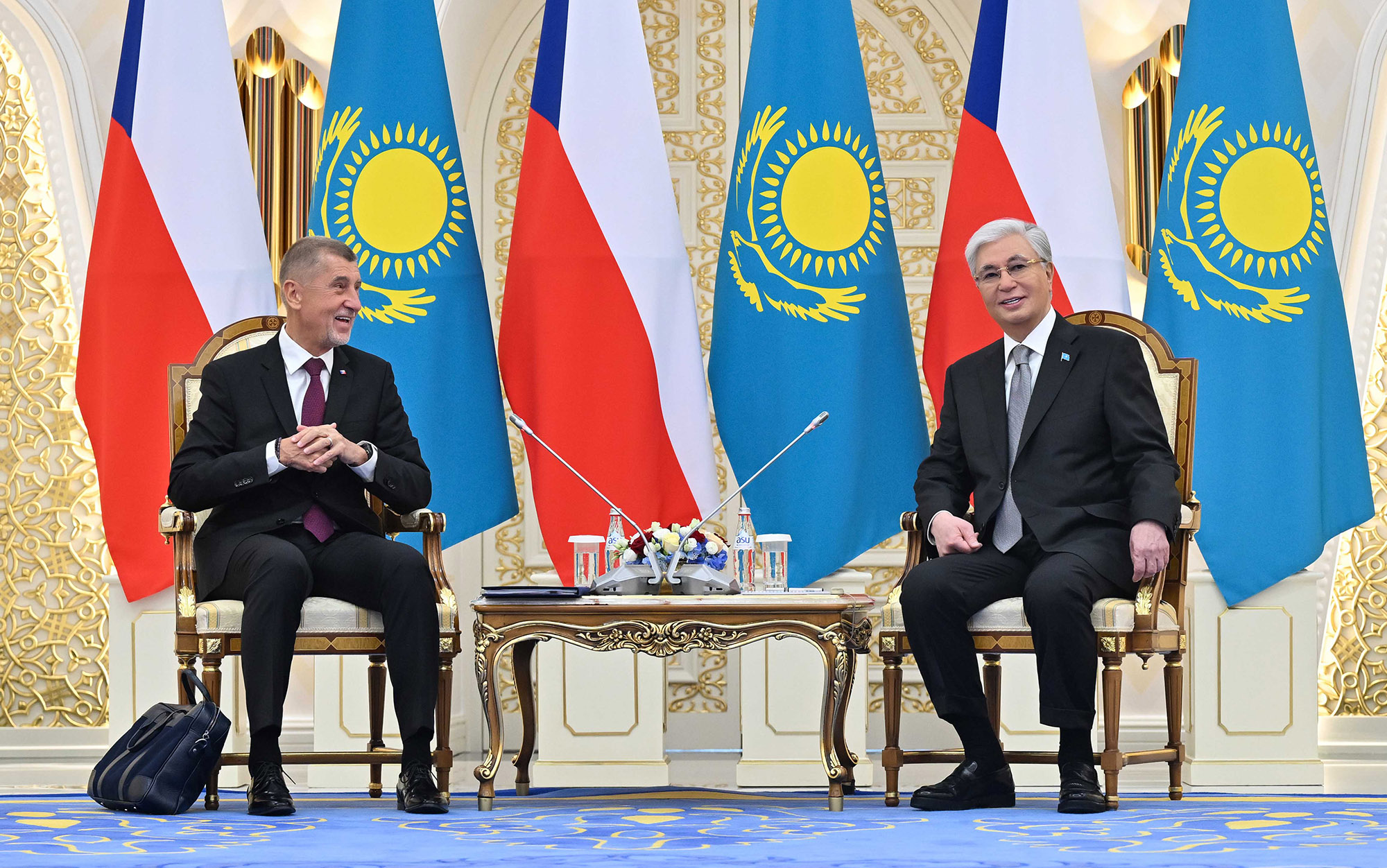
Today, relations between Kazakhstan and the Czech Republic are at a very good level and are acquiring a qualitatively new nature. There is strong political dialogue, growing economic ties and expanding people-to-people contacts. The recent official visit of Prime Minister Andrej Babiš to our country on April 28 and 29 gave a strong new impetus to our bilateral cooperation and demonstrated mutual interest in the further development of pragmatic and mutually beneficial cooperation.
We see untapped potential in cooperation with the Czech Republic
In recent months, Kazakhstan has been actively positioning itself as a reliable partner of the EU. How do you intend to further develop this role specifically in relation to the Czech Republic?
Kazakhstan is indeed committed to being a reliable and predictable partner of the EU and its member states, including Czechia. In the case of the Czech Republic, we see significant untapped potential. This includes opportunities in energy supplies, nuclear power, critical raw materials, transport connectivity between Europe and Asia and new consumer markets. All these issues were recently discussed during the high-level meetings in Astana.
And what about Kazakhstan’s role as a gateway to the Central Asian region?
Kazakhstan can serve as a gateway to Central Asia, a region of over 80 million people with steadily growing economies. Our country alone, with a population of around 20 million, accounts for approximately 60% of Central Asia’s GDP, according to national statistics.
Czech products have long enjoyed an excellent reputation in Kazakhstan for their quality and reliability. At the same time, we offer attractive investment conditions, including a favorable legal framework and investment incentives.
It is worth noting that Kazakhstan remains the leading recipient of foreign direct investment in Central Asia, accounting for roughly 60 to 70% of total FDI inflows to the region over the past decade, according to official data and international financial institutions.
A stable and predictable partner for energy and raw material supplies
In the current geopolitical context, there is frequent discussion about the diversification of supply chains and energy sources. What role can Kazakhstan play in this regard for Czech companies and investors?
Diversification has become a key priority globally and Kazakhstan is well positioned to contribute to this process. Moreover, as we can see, the Czech Republic has pursued a consistent policy of diversifying its energy partnerships.
We are a major supplier of energy resources, including oil and uranium – Kazakhstan is the world’s largest producer of uranium, accounting for over 40% of global output. In addition, we possess significant reserves of critical raw materials essential for green mobility and other high-tech production.
For Czech companies, Kazakhstan represents a stable and predictable partner for energy and raw material supplies, while also offering opportunities to localize production and develop regional supply chains. In addition, we are actively developing industrial capacities and special economic zones, which can serve as platforms for Czech investors seeking to expand into Central Asia and beyond.
We also connect Europe with Asia logistically
Your Embassy actively informs about opportunities in transport and logistics, particularly the Trans-Caspian Corridor. What concrete opportunities does this project bring to Czech companies?
The Trans-Caspian International Transport Route, also known as the Middle Corridor, is emerging as one of the key logistics routes connecting Europe and Asia. Today, a significant share of cargo flows between China and Europe – around 80 to 85% of containerized rail traffic along alternative Eurasian routes – passes through this corridor. In the current geopolitical environment, it represents an increasingly important alternative to northern and southern routes. For transport and logistics companies, this opens new business opportunities in freight forwarding, infrastructure development and supply chain management.
At the same time, there are bottlenecks that we must address jointly. These include the digitalization of logistics and trade procedures, expansion of port capacities on the Caspian Sea and the modernization of railway infrastructure. This creates a broad field of opportunities for Czech companies, particularly in engineering, transport technologies and smart logistics solutions.
Importantly, the development of the Middle Corridor is aligned with the EU’s Global Gateway initiative, which further enhances its investment attractiveness. To that end, Kazakhstan enjoys excellent partnership with the nations of the South Caucasus – Azerbaijan, Georgia and Armenia – which connect us with Europe through their territories and infrastructure for the transit of various commodities.
The scope for developing mutual cooperation is enormous
Czech companies have a strong tradition in industry, engineering and energy. In which sectors do you see the greatest potential for developing Czech-Kazakh cooperation?
Czech technologies and industrial know-how are highly valued in our country. We are interested not only in importing high-quality products but also in developing local production, service centres and joint ventures within Kazakhstan. Promising sectors include mechanical engineering, including the automotive industry, energy, both traditional and renewable, water management, and the modernization and digitalization of infrastructure networks, in particular communal energy supply. In addition, there are traditionally strong prospects in agriculture and food processing, as well as in healthcare and pharmaceuticals.
As you know, representatives of more than 50 Czech entities accompanied the Prime Minister during his visit to Astana. Among them were companies such as Omnipol, Škoda Transportation, AŽD Praha, ZVVZ, Mega, CSG and others. Together with 150 Kazakh companies, they participated in a bilateral business forum, held talks with potential partners and discussed concrete business opportunities. We look forward to seeing results in the implementation of contracts and joint projects.
The EU and Kazakhstan also emphasize cooperation in sustainability and the green transition. What concrete initiatives could connect Czech and Kazakh partners?
Sustainability and green transformation are among the key priorities of Kazakhstan’s development strategy. We are actively promoting renewable energy, energy efficiency and the development of a hydrogen economy. We also have significant potential in wind and solar energy, as well as in green hydrogen production. There is strong potential for cooperation with Czech partners in areas such as clean technologies, waste management, water conservation and energy-efficient industrial solutions.
At the same time, both countries are entering a new phase of the development of their nuclear power capacities. For our country, this means the construction of its first nuclear power plants, while Czechia is moving forward with the expansion of its nuclear sector through the construction of new reactors. As mentioned earlier, it is symbolic that Kazakhstan is already among the leading suppliers of natural uranium to this market.
We also see opportunities in the joint development of projects supported by European financial instruments and initiatives. Regarding water resources, our partners are currently working actively on the initiative put forward by the Kazakh leadership to establish an International Water Organization.
We have a lot in common
Your extensive diplomatic career includes, among other things, work with the UN, the OSCE and in senior positions in international diplomacy. How do these experiences shape your approach to bilateral relations with the Czech Republic?
Despite the geographical distance, Kazakhstan and the Czech Republic have a lot in common, including aspects of our recent historical experience. Both countries are landlocked and located in regions surrounded by major powers. In many aspects, we can be described as “rising middle powers.” This creates a natural basis for mutual understanding. For Kazakhstan, as for the Czech Republic, it is essential to uphold international law, in particular the principles enshrined in the UN Charter, including the principles of sovereignty and peaceful resolution of conflicts. We firmly believe that the UN remains the only universal platform capable of addressing global challenges. Our President Kassym-Jomart Tokayev has put forward concrete initiatives for UN reforms, including reform of the Security Council. In this context, cooperation among like-minded countries such as Kazakhstan and the Czech Republic is of particular importance.
Bringing our cultures closer together
What projects or events are you planning in the field of cultural diplomacy?
In recent years, we have organized a number of successful events, including concerts, film screenings and cultural days of Kazakhstan in the Czech Republic. This year in April, the Kazakh community organized a celebration of Nauryz (New Year) in Na Pankráci Park in Prague. Guests had an opportunity to witness a colourful cultural programme and try traditional dishes. This was the fourth year of the event.
We intend to continue this momentum. For example, on June 6, we traditionally plan to participate in the Festival of Embassies, which will take place at the markets at Kulaťák in Prague 6. We are also working on the participation of Kazakh ensembles in international folklore festivals across the Czech Republic. Such initiatives help strengthen mutual understanding and bring our peoples closer together.
Finally, what would you consider your greatest achievement by the end of your mandate in the Czech Republic?
As I have mentioned, my ambition is to elevate relations between Kazakhstan and the Czech Republic to the strategic level. At the same time, I would consider my mission successful if we are able to significantly deepen our economic partnership and bring tangible and sustainable results from our cooperation. This would include increased trade turnover, the implementation of major joint investment projects and stronger business-to-business ties.
On the other hand, if we manage to bring our countries closer together – through education, culture and human contacts – I would regard this as a meaningful achievement. Ultimately, diplomacy is about building bridges and I hope to contribute to building strong and durable bridges between our countries.
Mr. Abdrakhmanov was interviewed by Daniel Libertin
Photo: Embassy of Kazakhstan in Prague and the Office of the Government of the Czech Republic