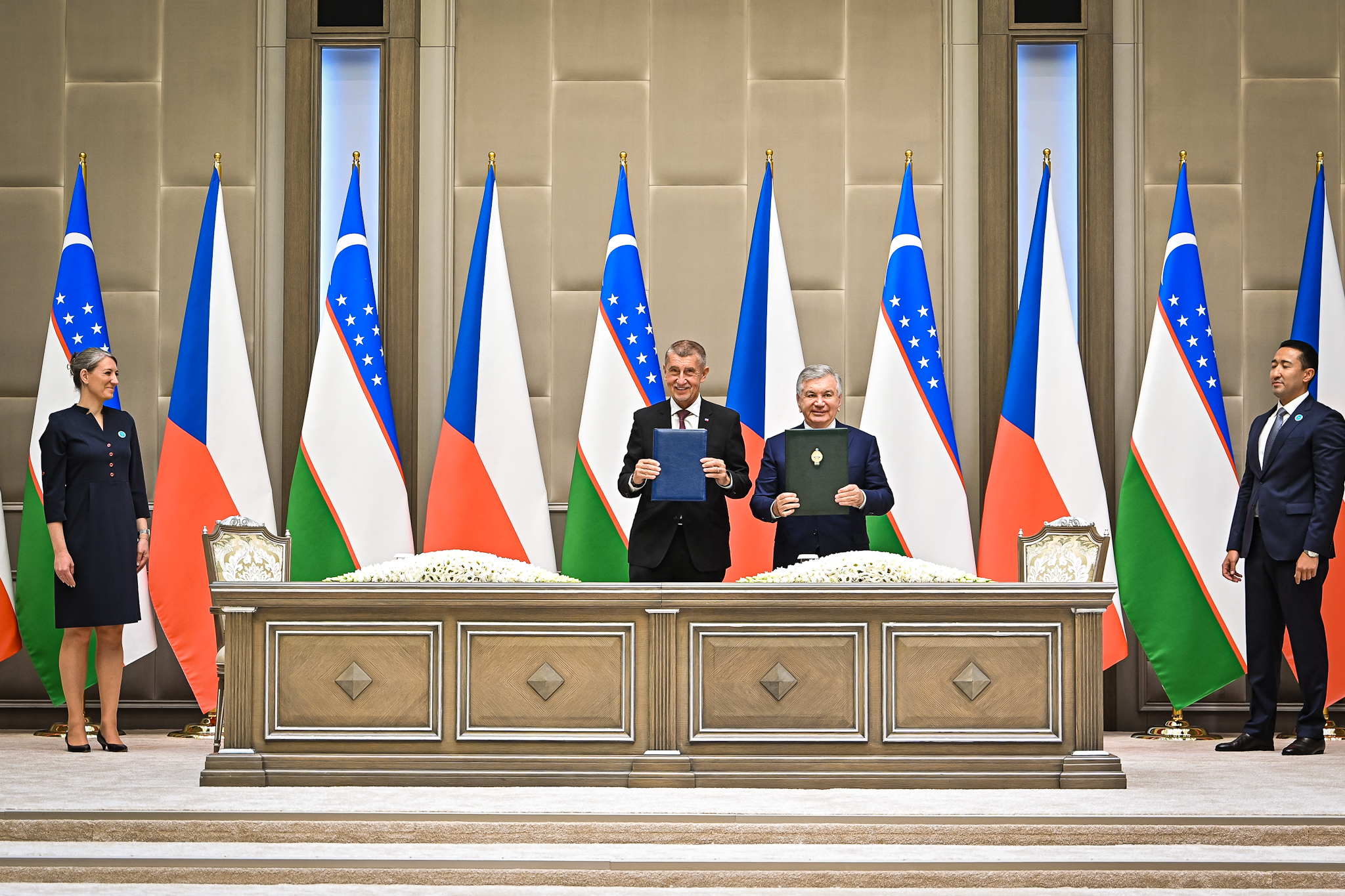
Relations between the Czech Republic – and the European Union more broadly – and Uzbekistan have been steadily developing in recent years, with both sides actively seeking opportunities for further expansion. We spoke with Dilshod Akhatov, the Ambassador of the Republic of Uzbekistan to the Czech Republic, who is based in Berlin, about current priorities and future prospects.
Your country is currently one of the fastest‑growing economies in the world and regularly ranks among a small group of consistently expanding emerging markets. What factors are driving Uzbekistan’s sustained economic performance? What lies behind this long‑term strong economic growth?
Uzbekistan’s economic development over the past ten years has taken place against the backdrop of profound structural change. Since 2016, the country has been continuously implementing reforms aimed at liberalizing the economy, modernizing the regulatory framework, increasing transparency and significantly simplifying business conditions. Despite external challenges, the national economy is showing stable annual growth of around 6-7 percent.
Innovative business models, digitalization and modern information technologies
Could you briefly outline the key factors behind your country’s economic development for our readers?
First, I would like to highlight economic liberalization and private sector development. Just as an interesting fact, in 2016, there were about 218,000 small and medium-sized enterprises; today, there are over 500,000. Second, there is investment, including in the “green” economy and “green” energy. And finally, development of innovative business models, digitalization and innovative information technologies.
Overall, the development strategy of New Uzbekistan places particular emphasis on industrial modernization, strengthening energy independence and promoting innovative economic sectors. The combination of macroeconomic stability, rising investment activity and demographic potential makes Uzbekistan one of the most dynamic economies in the region.
In 2023, the Czech Republic and Uzbekistan signed a bilateral ‘Enhanced Partnership’ agreement. How successful have we been in strengthening this partnership so far and how does this cooperation fit into Uzbekistan’s broader relationship with the European Union?
I would first like to note that the signing of the Joint Declaration on the establishment of Enhanced Partnership in 2023 is a natural continuation of more than thirty years of Uzbek‑Czech relations. Politically, it builds on a dense high‑level dialogue: visits by presidents and prime ministers of both countries, meetings on the sidelines of the UN General Assembly, regular contacts between foreign ministers and active inter‑parliamentary exchanges.
Economically, the partnership is already producing concrete results. Bilateral trade has been steadily recovering after the pandemic and exceeded $200 million in 2025. There are 44 companies with Czech participation operating in Uzbekistan, including 14 fully Czech‑owned enterprises. The Intergovernmental Commission on Economic, Industrial and Scientific‑Technical Cooperation is very active: ten meetings have already taken place, the latest in Prague in March 2025.
The Czech Republic is the gateway to Europe
How does this step fit into Uzbekistan’s broader relations with the European Union?
In the broader EU context, the Czech Republic is not just a bilateral partner but an important gateway to the European economic space. Uzbekistan is strengthening ties with the EU through the GSP+ preferential regime and the new Enhanced Partnership and Cooperation Agreement with the EU. Czech businesses, with their strong understanding of Central European and EU markets, can become key channels for bringing European technologies, standards and investments into Uzbekistan.
Looking at the history of Uzbek-Czech cooperation to date and considering the potential on both sides, in which areas do you see opportunities for deepening this partnership in the future?
Looking beyond the history of relations to the structure of both economies, the potential for Uzbek-Czech cooperation remains far from exhausted. Several sectors stand out where Uzbekistan’s interests and competencies of the Czech Republic align well.
High-quality technological solutions are in particularly high demand – industrial automation, mechanical engineering, energy-efficient and environmentally friendly technologies, logistics equipment and modern standards of sustainable production. Strong expertise of the Czech Republic in these areas ideally complements Uzbekistan’s economic modernization priorities and creates significant potential for partnership-based cooperation.
We are fully prepared to support Czech companies at every stage: from initial market analysis and partner search to the implementation of investment projects and participation in industrial clusters and economic zones. Our goal is to provide Czech companies with transparent, structured and secure market access in Uzbekistan.
Overall, cooperation is expected to evolve from traditional export-import relations toward more complex partnership models, including localized production, joint ventures, service centres and R&D cooperation.
The recent visit of the Prime Minister of the Czech Republic andrej Babiš, to Uzbekistan on April 29-30, accompanied by around 50 representatives of leading Czech companies, illustrates this trend.
Could you give some concrete examples of current cooperation between our two countries?
Earlier this year, Škoda Group presented its intention to enter the Uzbek market through a joint venture covering local assembly of railway vehicles, life-cycle maintenance and the creation of a training academy, with potential cooperation involving the European Investment Bank. This comprehensive approach aligns with Uzbekistan’s plans to modernize rolling stock and urban transport infrastructure.
In water resources and agrotechnology, Uzbekistan is shifting toward efficient irrigation, water monitoring and modern agricultural processing. Czech companies offer solutions in water treatment, precision irrigation, livestock technologies and agro-engineering, creating opportunities for pilot projects and agro-clusters.
Education is another strategic pillar. Universities such as Charles University, Czech Technical University in Prague and Masaryk University provide programs aligned with Uzbekistan’s priorities in engineering, IT and life sciences. Currently, around 300 Uzbek students study in the Czech Republic and this number could be increased several times through joint programs and academic partnerships.
When we think of Uzbekistan, we cannot avoid the painful legacy of the Aralkum Desert. Is the situation in the area of the former, now completely dried‑up lake improving?
Aralkum is, without exaggeration, one of the most dramatic environmental stories of the 20th century. For Uzbekistan, it is not an abstract issue but a matter of public health, agricultural sustainability and the future of an entire region.
Since 2018, our country has been implementing the national program “Green Aral Sea.” Its core element is large‑scale greening of the dried seabed of the Aral Sea, primarily through planting saxaul and other desert vegetation. To date, millions of hectares of Aralkum have been greened. Hundreds of thousands of hectares of new forest are planted annually and a “green shield” is being created to reduce dust storms and salt dispersion.
In parallel, international projects involving UNDP, the World Bank, the EU, FAO and others focus on pasture restoration, sustainable land‑use practices, support for local communities and development of alternative livelihoods.
Is the nature of intensive agriculture in the river valleys beginning to change as well?
Agriculture in river valleys is gradually transforming. The share of cotton is decreasing, horticulture and high-value crops are expanding, drip and precision irrigation are being introduced, irrigation networks are modernized and agro-processing is growing. This reflects a broader shift from water-intensive monoculture to a diversified and resource-efficient model.
Czech expertise in water treatment, landscape restoration, smart irrigation and agricultural engineering could complement these efforts, offering opportunities for pilot projects, technology transfer and joint initiatives supporting sustainable development in the Aral Sea region.
The most populous countries in Central Asia with a young population
Uzbekistan is the most populous country in Central Asia and has a very young population. Do you still expect that the updated demographic data will be available next year thanks to the latest census?
Uzbekistan has approximately 38.4 million inhabitants, which is nearly half of the entire population of Central Asia. It is also a very young society, with an average age of about 29 years.
The preparations for the new census are well underway, with results to be published in 2027. In the coming years we will obtain a highly detailed, up‑to‑date demographic profile – by age, education, migration and employment. This is important for domestic policy, investors and partners, including the Czech Republic.
How does cooperation between our countries function at the people‑to‑people level, particularly among the younger generation?
Education provides a solid foundation for people-to-people ties, which are further strengthened by growing tourism and direct air connectivity. Direct flights are currently operated by “Qanot Sharq” air carrier on the Tashkent-Prague route during the spring and summer seasons, while Uzbekistan Airways runs seasonal flights between Tashkent and Karlovy Vary.
These connections support increasing travel flows. Uzbek visitors are attracted by the historical charm of Prague and other Czech cities such as Český Krumlov, spa and wellness destinations including Mariánské Lázně, as well as recreation opportunities in Karlovy Vary. At the same time, Uzbekistan is becoming an increasingly attractive destination for Czech tourists, particularly cultural routes linking Tashkent, Samarkand and Bukhara, which combine Silk Road heritage, architecture and authentic cultural experiences. Expanding mobility and tourism is creating a promising new dimension of Uzbek-Czech cooperation and strengthening long-term people-to-people connections.
I am convinced that human capital and youth connections will shape the quality of Uzbek-Czech relations over the next 10-20 years just as much as trade and investment indicators.
Mr. Akhatov was interviewed by Martina Hošková
Photo: archive of the Office of the Government of the Czech Republic and archive of the Embassy of Uzbekistan in the Czech Republic