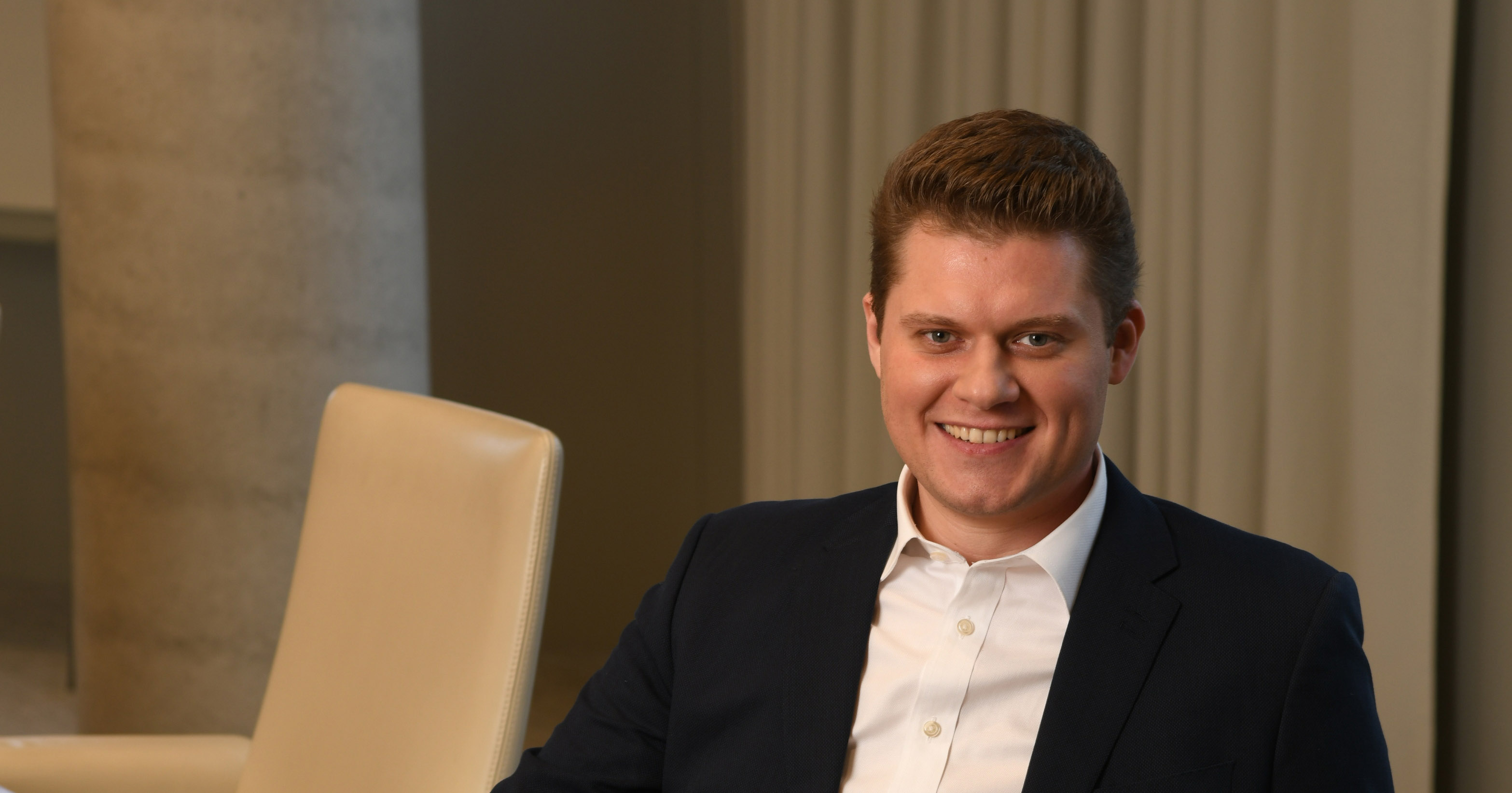
Last year, when the organizers of the Insurance Company of the Year Awards introduced a new category modelled on Western countries – Underwriting Team of the Year – the insurance industry eagerly awaited who would win the very first title in the Czech Republic. “We are proud that it was our team who received this prestigious award. Underwriting of industry risks is the showcase of every insurance company and reflects not only high professional expertise, but also great teamwork and cooperation with clients and brokers,” says Michal Krajčovič, Head of Industry Risks Insurance Division at ČPP, at the outset of our interview. A few days ago, ČPP also won the gold medal for industrial and business insurance awarded by brokers as part of the Insurance Company of the Year Awards.
Why do you think brokers ranked you at the very top?
Our underwriters are not only experts, but also salespeople and sometimes even psychologists. And they excel in all of these roles. We take great care of our clients, we are available to them virtually 24/7, regardless of weekends or holidays. They never hear from us that they called at the wrong time or that we are unwilling to help at that moment.
Naturally, the human aspect is complemented by the quality of our services. We strive for each of us to be an expert in the area of insurance we are responsible for, to be flexible and offer an individual approach and solutions that reflect the client’s specific situation and needs.
I also think it is evident that we genuinely enjoy our work. We enjoy finding solutions for every situation. And we are happy when we manage to insure a client in such a way that our colleagues in the claims department can pay the claim in full if an insured event occurs.
Most people would imagine that insurance companies do not like paying claims…
On the contrary, the claims adjuster’s concern is not saving money for the insurance company. They are happy when they can find a way, within the agreed policy terms, to pay a claim. And they are unhappy when it is not possible because they discover that the particular risk was not insured, or that they cannot pay the full amount because the client was underinsured. The task of our underwriting team is to set the premium at such a level that we have enough funds to cover claims. This means that we must correctly assess the risk and determine the appropriate premium amount. And that is often very creative and sometimes even a bit of detective work, with a touch of adrenaline involved.
Underwriting of industry risks is the royal discipline of the insurance industry.
At ČPP, we are not afraid of challenges
Please explain that to our readers.
It is mainly about an individual approach. A factory or a state institution simply does not fit into standardized insurance. We always try to find a solution for every client. We can also insure special risks because everything that is random can be insured. The only question is under what conditions. And those conditions must be carefully analysed and set.
Could you give an example of such special insurance with a touch of adrenaline involved?
For example, at ČPP, we have historically focused on certain types of financial risks – financial losses. This applies, for example, to event cancellation insurance. In practice, it works like this: an organizer preparing a large event, such as a concert, insures the costs of organizing it. If the concert cannot take place – for example because the performer falls ill or due to bad weather – and the organizer has to refund tickets, they suffer lost profits. We are able to insure such risks. Or I could mention prize indemnity insurance. ČPP is one of the few companies on the Czech market that can offer it.
How can a prize be insured?
I will give a specific example. We cooperated with organizers of a marathon, where if a runner broke the world record, they would receive a reward of one hundred thousand euros. The organizers insured this risk with us in advance, so they had the certainty that they would not have to pay this amount themselves – we would pay it instead. It is similar, for example, with golf tournaments, where a participant hits a hole-in-one and wins a car or a yacht.
Now I understand the adrenaline. How can such a coincidence – such a risk – be assessed in advance?
I will explain using the marathon example. We need to familiarize ourselves with the starting list and the individual runners in order to determine the probability that the world record will be broken. We must examine long-term weather statistics and estimate what the weather will be like during the marathon, since that will also have an impact on the result. And I could go on like this. We assess the risk, determine the premium amount, and then it is simply a matter of whether the record is broken or not.
So entrepreneurs can sleep peacefully
Let's go back to more common examples of business insurance. Can you find any aspects there that are often overlooked when policies are arranged?
Take business interruption insurance, for example. Most entrepreneurs understand this as insuring their fixed costs and projected lost profits in case an insured event occurs – their factory burns down, they are hit by floods, and so on. They think about the need to insure the period required to restore the business and resume operations. However, few of them know that it is also possible to insure situations where a similar disaster affects their supplier, on whom they depend, forcing them to interrupt their operations as a result. This is called contingent business interruption insurance, and I think it is very important today, even though it is not exactly the cheapest matter. For large corporate clients, we deal with such claims at least once or twice a year.
What other risk would you mention that is still underestimated?
Liability! Unfortunately, despite all our long-term educational efforts, some entrepreneurs still take it lightly. Yet they are responsible for their activities toward third parties, and if they cause damage to their property or health – whether through their product, service, etc. – they are liable for it. And today, compensation payments are high, and for most entrepreneurs a single event could be financially devastating.
What amount should liability insurance cover?
That really varies. A proper and good insurance intermediary will thoroughly question the client, analyse their activities, products and related risks – and recommend the correct insurance setup. For a hair salon, fifteen million crowns may be enough, but for car manufacturers it is billions of euros.
In the Czech Republic, we have a group of legally mandatory insurance products, such as liability insurance of health services providers. ČPP is strong in this segment as well, as we insure many hospitals, doctors and medical offices.
We meet clients halfway and try to fulfil their wishes before they express them
If you had to name two things that you are most proud of in your work, what would they be?
Personally, I am proud of how far we at ČPP have progressed since 1998, when we started offering business insurance. In the first year, premiums amounted to 10 million crowns. In 2010, when I joined ČPP, it was 700 million, and last year it exceeded 3 billion crowns. Under the umbrella of VIG, we have worked our way up to become one of the largest insurance companies, one that clients actively seek out themselves.
And the second thing I am proud of – for almost ten years, our team has been building know-how and a network of contacts in order to gain the ability to provide our clients with the services of international insurance programmes. This means that here in Prague, we can insure the client's business not only in the Czech Republic, but also their plant in India or the United States for example.
So if a Czech entrepreneur comes to you with the intention of doing business in Kazakhstan, are you able to advise them and offer a solution?
Yes, although Kazakhstan, Uzbekistan and other Central Asian countries are specific in terms of insurance and reinsurance because they are very closed markets and prefer to use local insurance companies. There are also certain legally mandatory insurance products there – for example, liability insurance for carriers and freight forwarders must always be insured with a local insurer – and we are able to arrange that. We can offer international insurance programmes from Prague even for these territories, but it is more complicated due to money transfers. In addition, local legislation requires a partner insurance company with which we must coordinate and align everything. Generally speaking, in these cases I would recommend international insurance programmes mainly for large multinational companies. For smaller clients, it is more advantageous to arrange insurance directly there.
Do these services apply to any country? And how do entrepreneurs use them?
Clients can come with requests regarding virtually any country, and we always try to find a solution. In recent years, demand for these services has been growing steadily. This is also connected to the fact that Czech companies are expanding abroad and achieving great success there.
We are one step ahead in sustainability and insuring green energy
It is known that ČPP supports sustainability and green energy with a special range of services. Could you explain this in more detail?
Green energy is a big topic in the insurance industry. We are talking, for example, about solar panels on roofs, and this year we expect a boom in the construction of battery storage systems for companies. We try to provide services not only within insurance itself, which must be individually set up, but we also explain that it is useful to consult the insurance company much earlier before clients start building these facilities.
It often happens that a company has photovoltaics improperly installed on a facility full of production machinery and inventory worth billions of crowns. The risk of fire then increases enormously. Over the past three years, most fires have occurred precisely due to improperly installed solar panels – for example because they were connected through a lightning rod or placed next to a gas pipe.
So what do you recommend?
As part of our risk management services, our colleagues visit the client and assess the risk. They evaluate whether everything is installed correctly and whether the client takes proper care of these installations. Ideally, however, we advise them before implementation on how to install these systems correctly, or, based on the project documentation, we explain what needs to be changed. Often, all it takes is to move the battery storage system half a meter farther from the building or install arc protection with the photovoltaic system – and the client will pay significantly less for insurance.
Love for the insurance industry
From everything you have said today, it is obvious that you truly love your profession. This is also evident from the fact that you work for your alma mater, the Prague University of Economics and Business, and lecture students in your field there. What would you like to pass on to them?
I enjoy it, also because when I was studying, I missed contact with real practice. Insurance was my major field of study, but when I started working, I found out that reality was completely different. My desire is to show students how things truly work in practice and attract them to this field.
Unfortunately, I think the insurance industry still carries a negative label from the 1990s, and few people see it as a fundamental pillar of our economy. I would like to show students the beauty of insurance.
Michal Krajčovič was interviewed by Jana Jenšíková
Photo credits: ČPP