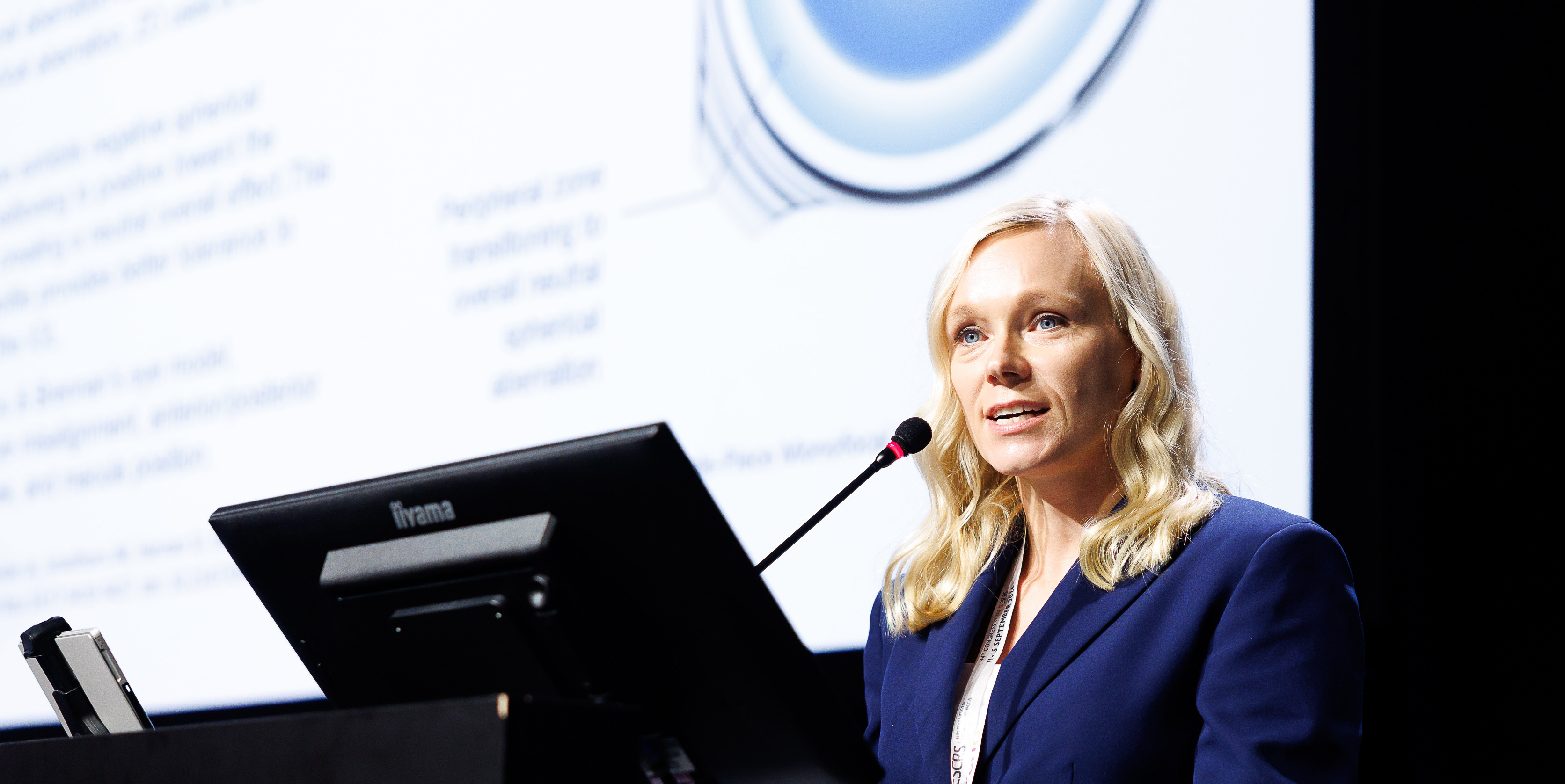
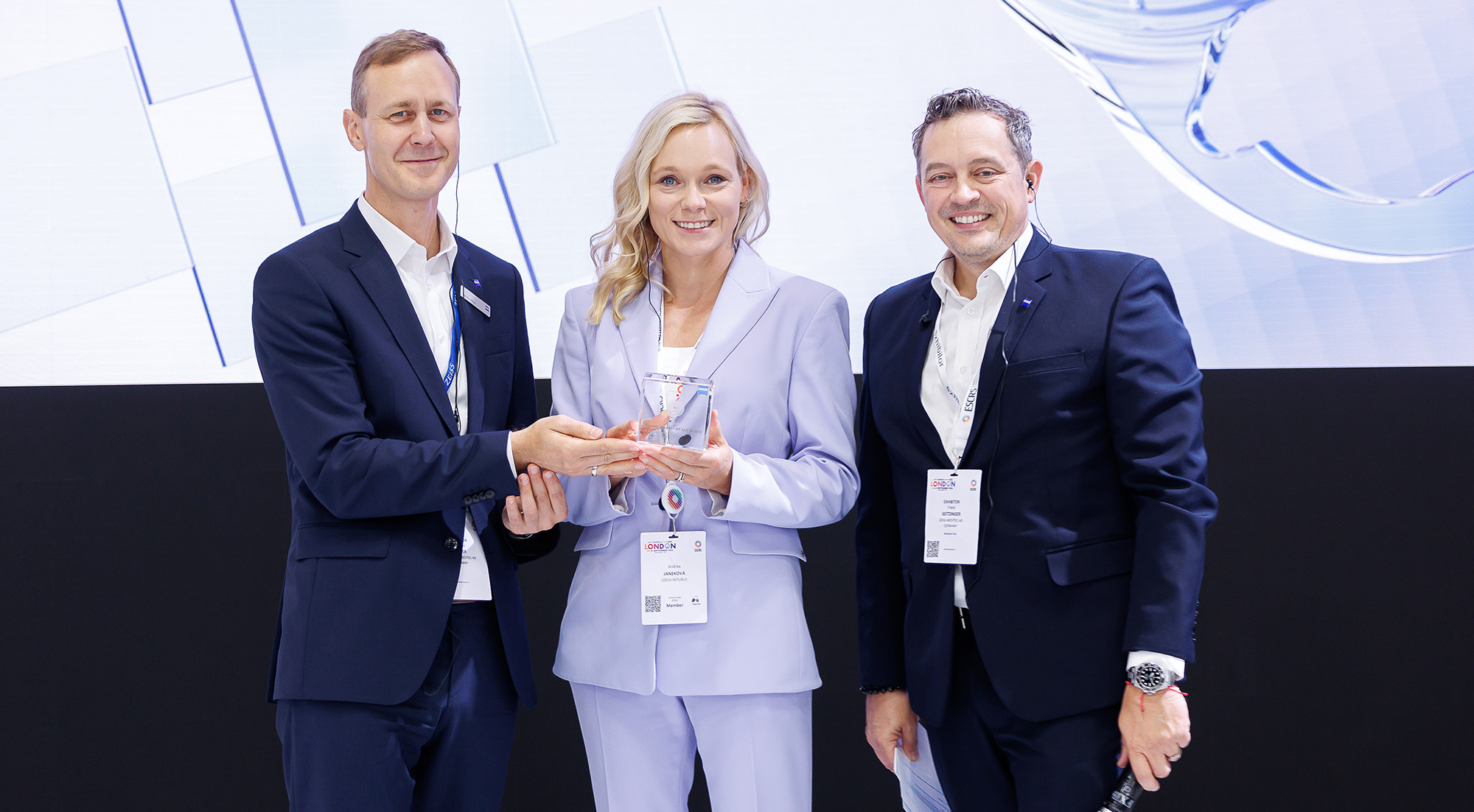
On the morning of Saturday 12 September, seven leading experts from six countries gathered at London’s ExCeL exhibition center during the 44th Congress of the European Society of Cataract and Refractive Surgeons (ESCRS) to receive the prestigious ZEISS AT LUCIA Toric Pioneer Award for their pioneering role in introducing a new intraocular lens technology. This year’s ESCRS Congress was one of the world’s largest meetings in the field, attracting over 17,000 participants from 135 countries. The Czech Republic was also represented among the award recipients by Andrea Janeková, Head of Cataract, Refractive and Vitreoretinal Surgery at Prague Eye Centre. This spring, she became the first surgeon in the world to successfully implant this new lens in a patient suffering from cataract and astigmatism.
Czechia among the world’s best
Doctor, what goes through your mind when you receive an award in front of so many international colleagues?
It was a wonderful feeling and an exceptional moment. I had the honour of being among just a handful of colleagues from around the world, and ultimately I was able to perform the world’s very first implantation of the ZEISS AT LUCIA toric 721P lens and subsequently become part of a small international group of surgeons gaining the first clinical experience with this new technology.
What began with the first implantation in Prague has grown into a successful project, thanks to months of clinical practice, data collection, and collaboration with a top-tier international team of surgeons. The official launch of the AT LUCIA toric intraocular lens at the ESCRS Congress in London is therefore an extraordinary milestone for us that gives all this work a deeper meaning.
I thanked ZEISS Medical Technology for their trust and the opportunity to be part of this story. My thanks also went to all the colleagues involved and, of course, to my entire team at Prague Eye Centre.
After all, innovation and progress are not the work of a single person. They are built on trust, collaboration and the willingness to take the first step.
A new generation of intraocular lenses
Could you briefly describe the advantages of the new intraocular lens?
Toric lenses have been helping patients for several years. However, the innovative AT LUCIA toric 721P model brings further improvements. Thanks to its state-of-the-art patented material, it maintains its shape exceptionally well. Its greatest advantage, however, is its unique design – it is the only lens on the market with a toric surface on both the front and back, ensuring even more precise vision correction.
It is designed to simultaneously correct cataract and astigmatism, ensure precise and stable positioning in the eye, and provide patients with excellent long-term visual outcomes.
For instance, our first patient, a 77-year-old woman who underwent surgery on both eyes, achieved 100% visual acuity just one day after surgery, with her astigmatism fully corrected. She can now see clearly, sharply and without distortion.
Innovation is not the work of a single person. It is built on trust, cooperation and the willingness to take the first step.
MUDr. Andrea Janeková received the prestigious ZEISS AT LUCIA Toric Pioneer Award at the 44th ESCRS Congress in September 2026.
Open sharing of experience is essential to successful treatment
You regularly speak at international ESCRS congresses, and this year you were once again one of the key figures in the scientific programme. Among other things, you presented the first real-world clinical data on the new lens to an international audience and served as a panellist in the interactive ESCRS Arena discussions focused on complications in refractive surgery. What impressed you the most?
I think it was the ESCRS 2026 Arena forum. That specific format of sharing experiences suits me best. A packed room, a panel of top refractive surgeons and real, complex cases from clinical practice. The most valuable aspect is the absolute openness – discussing how to actually proceed when things don't go according to plan. It is precisely the clash of different perspectives, varying approaches and sometimes even conflicting opinions that gives the entire debate such immense value. No formal presentations, just pure clinical practice, interaction with the audience and an honest debate about solutions. These are the kinds of meetings you learn the most from.
Every success like this advances not only the technology itself, but above all the quality of care we can offer our patients.
International ophthalmology wet lab comes to Prague for the first time
International collaboration is an integral part of your career. In addition to your surgical practice, you regularly lecture and serve as an instructor at professional congresses and wet labs across Europe and around the world. Furthermore, Prague will soon host the first international iSCOPE ophthalmology wet lab, which you initiated and whose scientific programme you lead. What inspired you to undertake this ambitious project?
From my own experience, I know that it is impossible to learn eye surgery solely from textbooks and lectures. A young ophthalmic surgeon primarily needs the opportunity to practise individual surgical steps repeatedly under the supervision of experienced colleagues. Yet, such opportunities remain scarce. That is why Prague will host the international surgical course iSCOPE: Prague Ophthalmic Wetlab for the first time. We anticipate the participation of doctors from more than ten European countries, and will offer them intensive hands-on training in ophthalmic surgery under the guidance of Czech and international experts.
For a young surgeon, it is incredibly valuable to watch an experienced specialist at work, have the opportunity to ask questions and then try the procedure themselves. Which leading ophthalmic surgeons have you managed to bring to the first Prague wet lab?
I have managed to put together a fantastic international team of instructors. It includes prominent medical figures from Portugal, the United Kingdom, Switzerland, Austria and Germany. One of them is Professor Arne Viestenz from Germany, a leading figure in European ophthalmology whose clinical practice focuses on complex surgical cases and the management of complications. We also have the support of Michael Gundrum, CEO of the Austrian company MTS, which specialises in ophthalmic wet-lab training and is also involved in the iSCOPE project.
It won’t just be the team of instructors and organizers that is international, but also the participants themselves, who will be coming from many different countries. What is your greatest expectation?
I would like iSCOPE to demonstrate that Czech ophthalmology has a great deal to offer on the international stage and that the Czech Republic can become a place where doctors from abroad come not only for treatment, but also for top-tier professional education.
The event’s significance is underscored by the patronage of Minister of Health Adam Vojtěch. The event has also received European accreditation from the EACCME®, enabling participants to earn European CME credits.
The organisers’ ambition is not merely to hold a one-off course, but to lay the foundations in Prague for a long-term international educational platform.
Ms. Andrea Janeková was interviewed by Jana Jenšíková
Photo credits: Prague Eye Centre and ESCRS