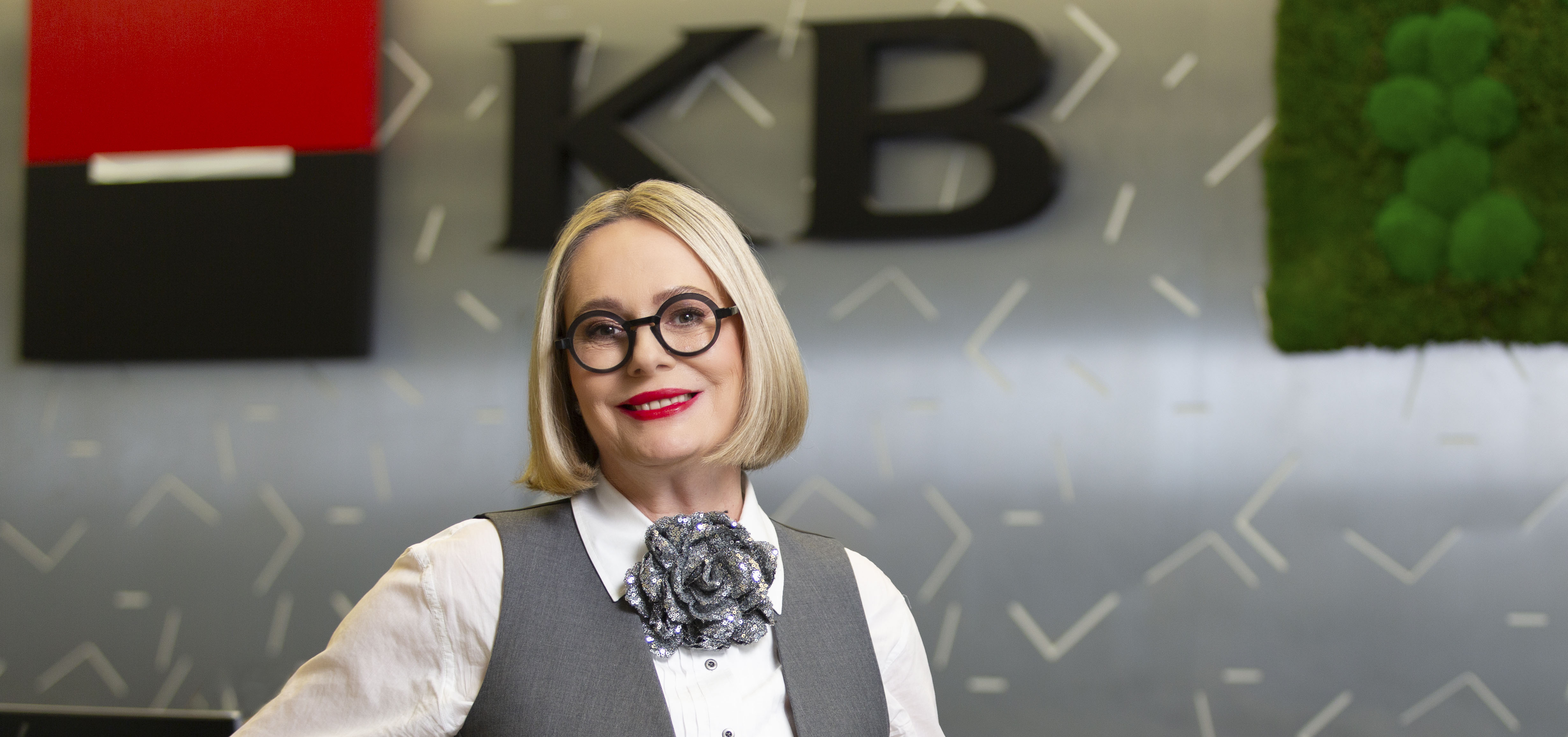
A year ago, Katarína Kurucová joined the Board of Directors of Komerční banka with a clear vision: to bring corporate and investment banking back into the spotlight and strengthen its position in the Czech market. In this exclusive interview for TRADE NEWS, she discusses the progress made towards achieving this goal, the role of artificial intelligence, the needs of businesses, as well as values and the pursuit of stability in turbulent times.
In our previous interview, you emphasised the need to bring corporate banking back into the spotlight at Komerční banka. What have you managed to change over the past twelve months?
I believe corporate banking is now much more visible on KB’s strategic agenda. This is also confirmed by our recently announced strategy for the period ahead. It clearly states that KB maintains a leading market position in key corporate segments. We value this greatly, and these are precisely the foundations we want to build on further.
Looking at the actual results, how has this increased visibility translated into the bank’s financial performance?
I am proud that corporate banking is delivering the expected financial results this year and that we are meeting our approved budget. At the same time, we are maintaining strict discipline in cost control and risk management. Our client portfolio is healthy, which proves that we are doing our job professionally. Corporate clients generate 40 per cent of the bank’s total revenues, and it is still true, that every other company in the Czech Republic has a business relationship with Komerční banka.
Leaving your mark on someone else’s success and hearing clients say they see you as a genuine partner is the best possible reward.
Last time, you also mentioned that to strengthen the position of the corporate segment, it is necessary to intensify and improve the quality of the dialogue with the parent group, Société Générale, in France. Have you seen progress in this area?
Our French majority shareholder is demanding. It is only natural that they pursue its interests and seeks to steer Komerční banka towards process models that work in their home market or in other countries where the group operates. While communication can be challenging in certain specific areas, the key point is that we have encountered no problems with the approval of transactions for our key clients that require validation directly in France. On the contrary, I feel that the parent group appreciates the business we bring to the overall corporate structure. Our transactions are attractive both in terms of economic performance and the compelling success stories of Czech companies.
Moreover, the Czech Republic is home to a highly successful group of clients who have long since grown beyond the domestic market and evolved into major European or global players. Naturally, these companies attract enormous interest throughout the Société Générale group. That is one reason why both sides are always willing to find common ground. On the other hand, every shareholder expects a clear return on their investment. Therefore, profitability and efficient allocation of capital that our transactions must deliver are monitored very strictly.
Time as the most valuable commodity
When you arrived from Slovakia a year ago, you mentioned how much you enjoyed visiting companies there in person. We ended our interview on the note that you were looking forward to getting to know the Czech business environment better. Have you managed to find enough time for that?
Unfortunately, not as much as I would have liked, which I truly regret. Currently, the time I devote to the bank’s overall corporate agenda is not quite in balance with the time I could spend directly with our clients. The bank is going through a period of major challenges, the most significant of which is its overall transformation. We are building an institution that is future-ready, which naturally involves an enormous amount of change and requires an exceptional commitment of time.
However, I have a fantastic team around me, and I am immensely proud of them. Thanks to their full commitment and professionalism, our clients are not affected by my limited personal availability. My colleagues look after them with the utmost care, while I try to act as a shield, protecting the team from portion of internal banking processes and administration so they can focus entirely on our partners' business.
For managers today, time is the most valuable commodity. We often hear that artificial intelligence, which is making significant inroads into the financial sector, will help us save time. How do you view this technological boom?
I am a great optimist and enthusiast when it comes to artificial intelligence. I believe that if we approach technology and AI in the right way, they can help us enormously in business. They can take tedious routine work off our shoulders and create room for creativity and strategic thinking. In short, we will delegate monotonous tasks to a digital colleague, leaving us humans more time for what matters most: meeting clients in person and creating new value.
When people do what they enjoy, they succeed at it and can be among the very best.
Admittedly, we are currently in a rather particular transitional phase, when many people feel that new technologies are taking up more of their time and making life more complicated. But this is natural. We are still learning how to work with them and defining what we should actually expect from them. In the long term, however, I remain optimistic: AI and new technologies will become key and highly effective assistants.
Where specifically do you see the greatest potential for AI within the bank’s internal processes?
Banking is subject to a broad and complex regulation and administration. A typical example is compliance, monitoring and assessing payments for suspicious transactions, which is strictly required by legislation and regulation. This is exactly the kind of repetitive work that a machine can perform much better, faster and with much greater capacity. If we delegate these necessary but routine activities to technology, we will significantly increase efficiency and free up our people. They will have more time for work they genuinely enjoy and find fulfilling, rather than work that is necessary purely for procedural reasons. And when people do what they enjoy, they succeed at it and can be among the very best. We could then become not only an efficient bank but also, to put it a bit playfully, a “happy bank”, where people can genuinely say they love their jobs.
I am a great optimist when it comes to the adoption of AI. I believe that if we approach technology and AI in the right way, they can help us enormously in business.
Human element remains a priority for corporate clients
How do you envisage balancing this push toward technology and AI adoption with the personal approach that has traditionally been the cornerstone of corporate banking? Does the combination of quality, price and the human touch still remain the deciding factor?
Absolutely. This has also been confirmed by our extensive annual client survey, in which we ask companies whether they would recommend Komerční banka as their key financial partner. The role of the relationship manager and the human element in general continue to stand out as the single most dominant positive factor.
Was there anything in this year’s data from corporate clients that surprised you?
Yes, for the first time, we saw a strong expectation for a technological shift and digitalisation. In the past, we perceived these demands as being more prevalent among retail clients. Now, however, it is becoming clear that senior managers and business owners also demand the greatest possible simplification of processes and a modern digital approach. We are looking closely into whether this is due to a natural generational change in company leadership, or if the standard across the entire market has simply evolved. We now need to analyse this feedback in detail. We want to target our technological support and future development with absolute precision so that we can fully meet these new needs of modern business.
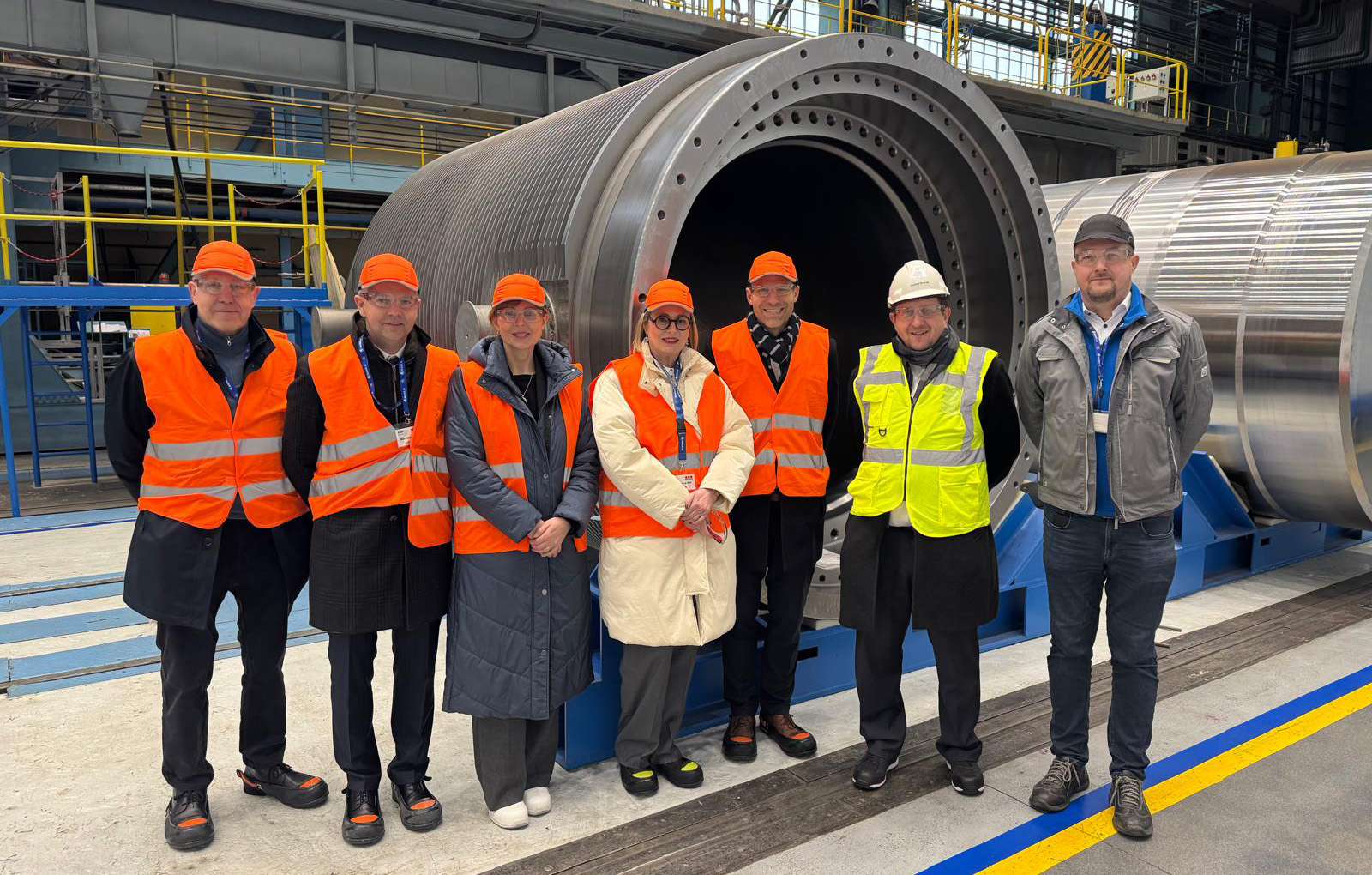
From this year’s visit to the industrial site of Škoda JS, a long-standing client of Komerční banka
A well-structured business partnership can withstand difficult times
In your view, what are the most common mistakes companies make when financing their growth?
It is very tempting for companies to run repeated tenders and try to secure the most favourable terms and the lowest possible price from banks. In principle, this is a legitimate role for a CFO: to find the most efficient form of financing. Throughout my career, however, I have also encountered CFOs who treated the tender process almost like a sport, repeating it every year. Eventually, this approach lost its appeal for the banks. And when tougher times arrived, whether for the client or in the financial markets, these were precisely the clients who felt the negative consequences first.
A business partnership must always make profound sense for both parties. If it does, the bond is strong and will survive both good times and bad. Pushing terms to the absolute limit may seem like the right move in the short term, but management must also view financing through the lens of crisis scenarios and full economic cycle, not just today’s success.
So what should be the main anchor for companies in today’s turbulent times?
Entrepreneurs must think ahead and not assess their situation only in terms of the current year or the particular thing they need to finance at the moment. You are right that we live in difficult, turbulent times. Companies face many obstacles, above all instability in the domestic and international environment. It is therefore absolutely essential for every company to maintain a healthy financial reserve and a clear vision. More than ever, management should actively focus on risk management.
The key is to find the right balance between equity and debt financing. The level of uncertainty in today’s world is high. However, a strong bank offers a long-term, predictable relationship that supports a company even when it is temporarily struggling, because it believes in its business and the people who lead it.
The importance of continuous dialogue
You mentioned predictability. What exactly does that mean in the relationship between Komerční banka and a corporate client?
In business, predictability has many meanings. When a client asks us for a loan, they expect a predictable timeframe within which they will receive a clear decision. If the answer is positive, they need to receive a clear and transparent loan agreement setting out the terms within a reasonable timeframe, and the list goes on. That is the basic level of the relationship. Beyond that lies mutual trust, which is not something that can be built in a single year.
We often become involved with our clients in investment projects that are completely new even to them. We try to discuss these plans with them in depth. Sometimes they might not be particularly fond of us for this, because we are strict and want to know in detail what the project will look like in five years. Of course, none of us has a crystal ball, so we sometimes have to temper an entrepreneur’s natural optimism. But we must not go too far, because any investment can easily be killed off if you dismiss all its parameters out of hand. That is precisely why continuous dialogue is so important to us: an investment is our joint project and a shared assessment of the future, and neither side wants any unpleasant surprises two or five years down the line.
We all need more certainty
Speaking of the future, what is your greatest wish for the coming year?
On a global level, I would wish for less uncertainty in the world. I feel that the level of both geopolitical and economic uncertainty has reached a point that is now unnecessarily exhausting for both business and society.
As for Komerční banka, I would like the transformation we are currently undergoing to successfully complete its main phase next year. I want us to enter a more stable period that will be clearer and more predictable for both management and our employees.
And of course, I hope we will continue to have enough energy and strength to bring innovative solutions to our clients and carry out new projects with them. Corporate banking is a fascinating field. It allows you to experience countless different business stories. It is simply a wonderful job, and my greatest wish is for it to retain that beauty and energy.
That beauty probably lies in being able to see tangible results from your work. Is that right?
Exactly. When a deal works out and a client successfully builds something, you know the bank has played a part in that success. We help create value and see tangible results. It is an incredibly fulfilling feeling when you walk into a production hall and the business owner spontaneously tells you that they built the facility with our help. Leaving your mark on someone else’s success and hearing clients say they see you as a genuine partner is the best possible reward.
Moreover, this principle applies across the entire market, from smaller businesses to the biggest players. I recently heard Daniel Křetínský, one of the most prominent figures in Czech and global business, speaking on stage. He mentioned that, at the very beginning of his business career, it was crucial that Komerční banka believed in him and granted him a loan. In a sense, that was the first brick laid for the skyscraper he went on to build. I greatly appreciate it when people who have built global empires publicly acknowledge the bank’s contribution to their success. It is an enormous honour for us and a confirmation that our work has profound meaning.
Katarína Kurucová was interviewed by Jana Jenšíková
Photo credits: KB